I was recently watching The Americas on Peacock, narrated by Tom Hanks, and one scene from the Amazon Rainforest stayed with me.
It was about army ants.
These ants move through the forest in highly coordinated groups. They travel together, search for food together, protect each other, and survive through cooperation. Every ant plays a role, and together they form what scientists call a "superorganism."
But the part that stopped me was much smaller than that.
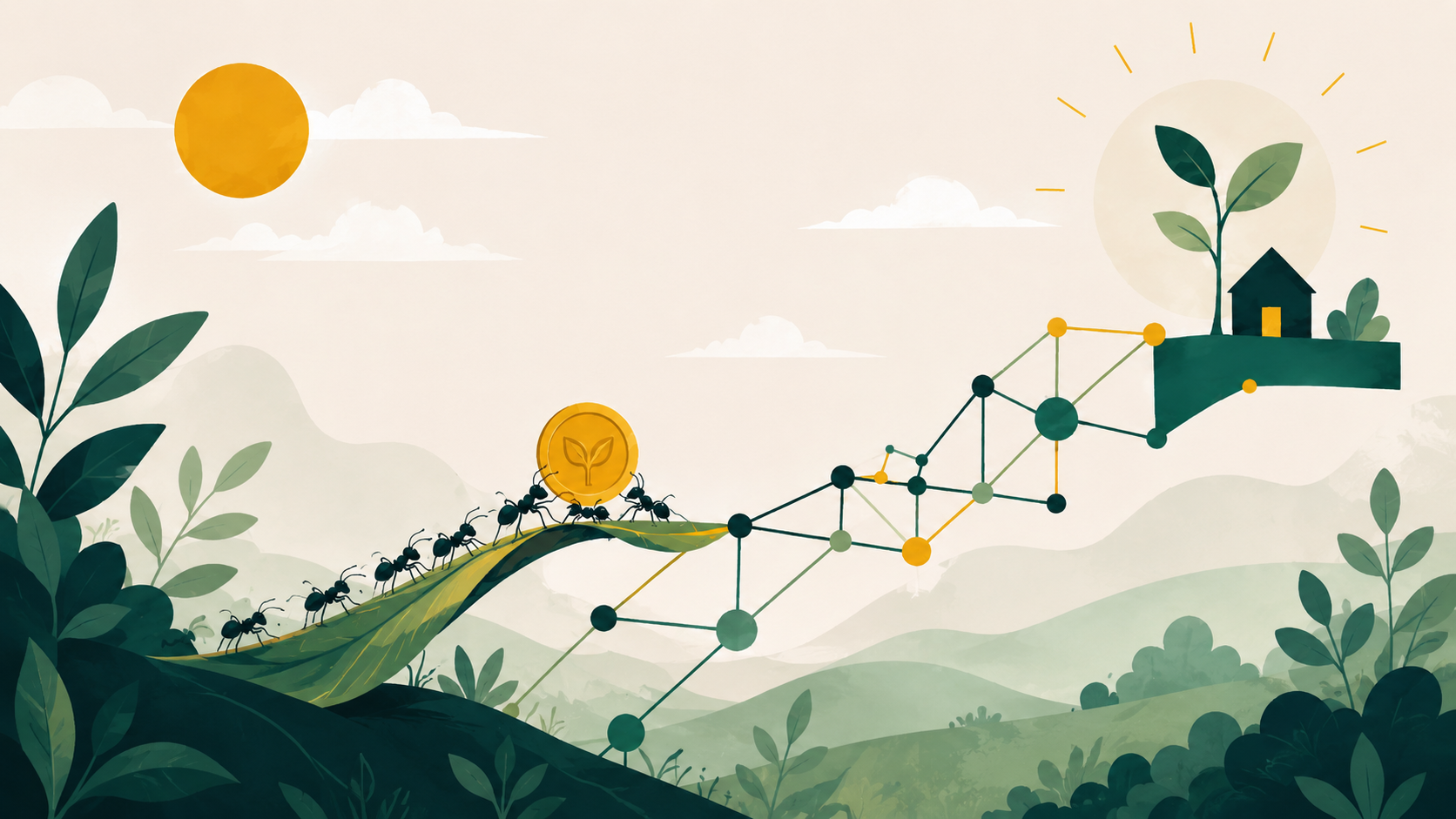
In one scene, a larger ant is carrying food back to the colony. To get there, it has to climb onto a raised platform. As it approaches, the smallest ants step in. They stretch out their bodies and legs, forming a living ramp so the larger ant can make it up.
It was a small moment. Almost funny at first.
But I couldn't stop thinking about it.
Not because people are like ants, but because nature was showing something powerful about structure.
When every contribution matters, when trust guides the system, and when the group is organized around a shared outcome, small individual actions can create something much bigger than any one person could build alone.
That's the heart of a susu.
Long before credit scores, loan applications, underwriting models, and denial letters, communities were already creating financial systems based on trust. Across Africa, the Caribbean, Latin America, and neighborhoods across America, people pooled what they had, took turns, held each other accountable, and helped one another move forward.
No bank branch required.
No FICO score required.
No one waiting behind a desk to decide whether they were worthy.
Just people building financial access together.
That's what often gets misunderstood about community finance. People hear "susu" and think it's informal, small, or old-fashioned. But I see something different. I see one of the most resilient financial ideas ever created.
Because when trust is structured, it becomes capital.
A susu isn't charity. Everyone contributes.
It isn't a handout. Everyone has a role.
It isn't random. There's order, accountability, rhythm, and trust.
For generations, families and neighbors have used systems like this to cover emergencies, pay bills, start businesses, send children to school, and create opportunity when traditional finance was out of reach.
The modern financial system often acts like it invented access.
It didn't.
Communities did.
Susu Lend exists because I believe those communities were never lacking financial intelligence. They were lacking tools, recognition, and infrastructure.
The wisdom was already there.
The trust was already there.
The structure was already there.
What technology can do now is help make that structure safer, more transparent, and more powerful — without stripping away the community that made it work in the first place.
That's the future I believe in.
Not finance that looks at people as isolated data points.
Not finance that reduces someone's worth to a single score.
But finance that understands what communities have always known: people are stronger when they're connected, accountable, and able to move forward together.
The ants didn't teach me something new.
They reminded me of something I've believed for a long time.
When trust is real, when contribution is shared, and when the structure is built the right way, community does more than help people survive.
It helps people rise.